

I’ve been having a really good time with AI agents lately. Not in the way people tweet about productivity gains. I mean the kind of fun where you look up and it’s 1 AM and you forgot to eat dinner because you’ve been building something and it actually works. That kind of fun.
A few weeks ago, I wrote a post called My Girlfriend Doesn’t Know What Git Is. She Just Built an Entire CMS. Huge post. You should check it out if you haven’t. The idea is that AI is now enabling us to create anything we think of.
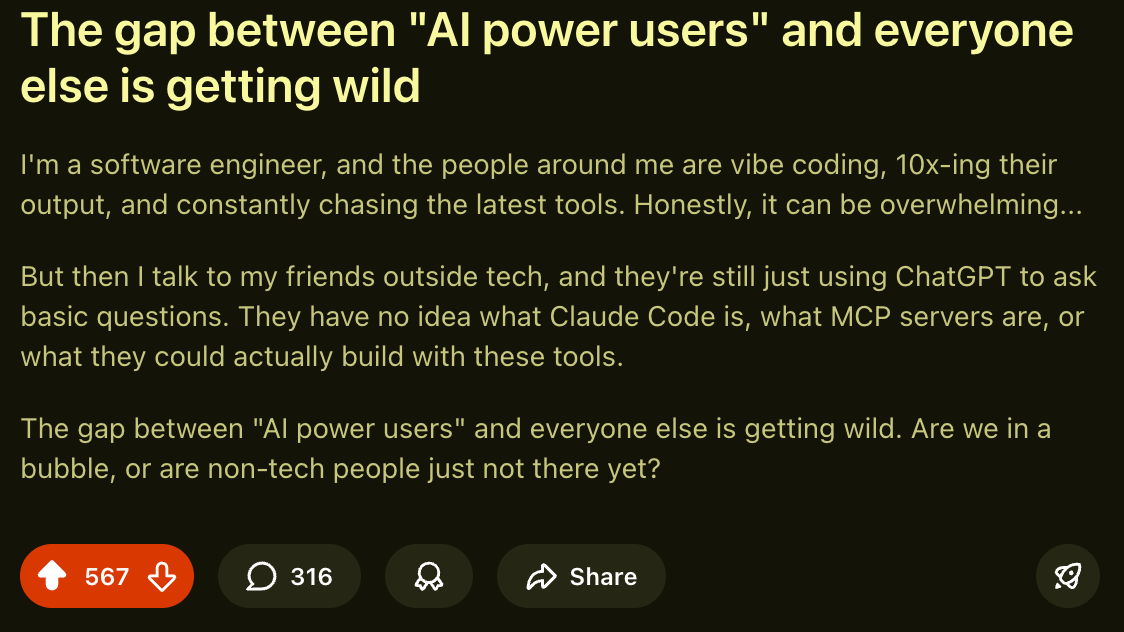
The tech people got it. They’d seen the same thing in their own lives, especially at work. But my non-tech friends? One said “cool” and pivoted to weekend plans. What felt world-shifting to me was invisible to most people I know. Not because they disagreed with it, but because it didn’t register as relevant to their lives at all. Which made me wonder: are we actually in a bubble? The gap between “AI power users” and everyone else is getting wild.
Taking the questions to Reddit
The next reasonable thing to do was take the question to Reddit. To my surprise, that post went viral. My karma score tripled.
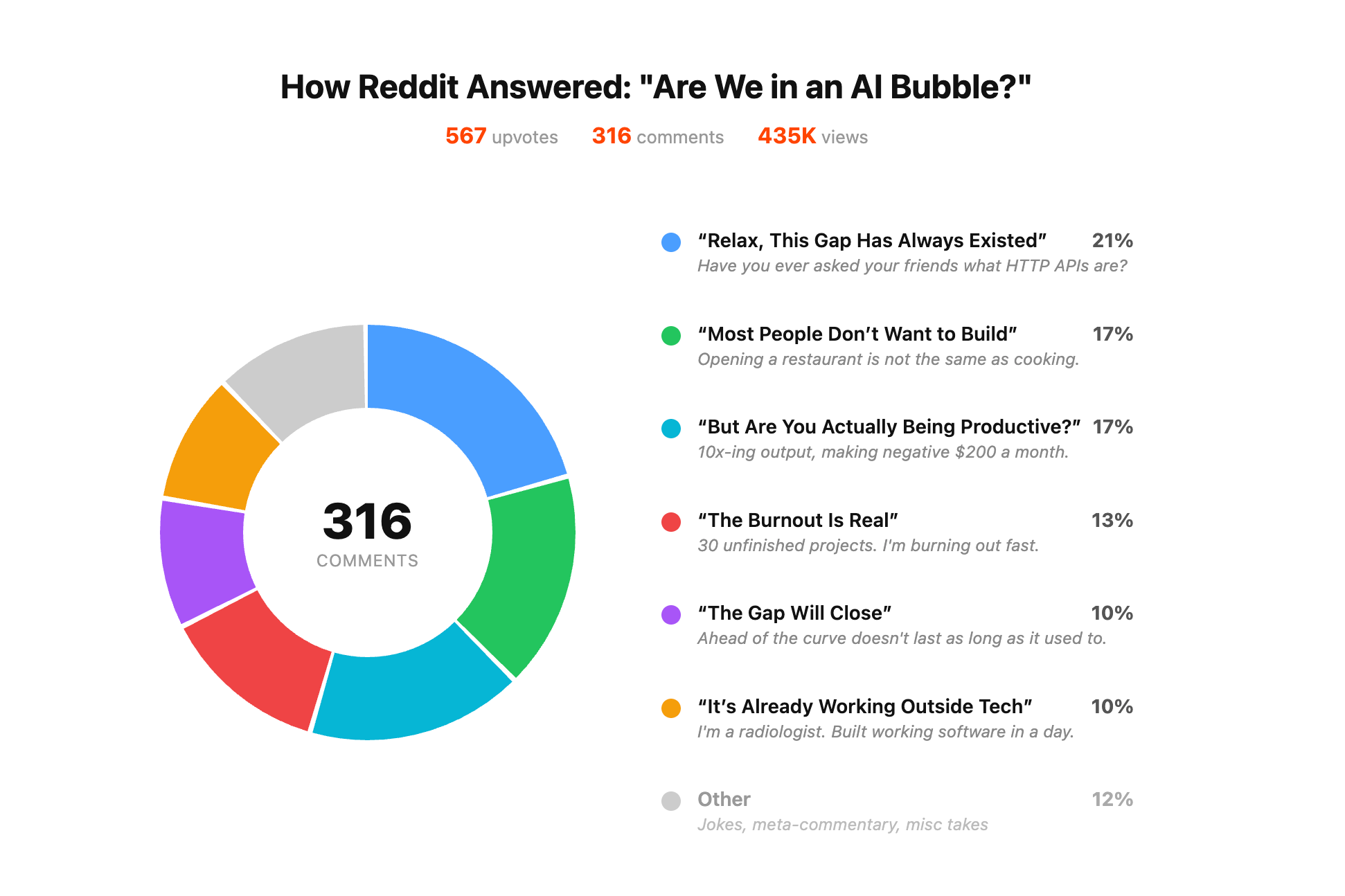
What struck me wasn’t any single comment. It was how the comments fell into patterns. I grouped them into 6 distinct categories:
“Relax, This Gap Has Always Existed” at 21%
“Most People Don’t Want to Build” at 17%
“But Are You Actually Being Productive?” at 17%
“The Burnout Is Real” at 13%
“The Gap Will Close” at 10%
“It’s Already Working Outside Tech” at 10%
“Relax, This Gap Has Always Existed”
The most upvoted comment had 244 upvotes. It said:
Have you ever asked your friends outside tech what HTTP APIs, VSCode, Python or any other tech related thing is? Always has been the case.
Someone else put it more bluntly: Do you know about the latest technology in dental medicine? Or plumbing?”
Another compared it to quantum physics: I have the same issue when I talk about quantum physics with my friends. It’s like they live in a completely different world.
And yeah. Okay. Fair. But here's the thing: a lot of the people in that subreddit thread weren't technical. The gap is closing whether we notice it or not. You don't see me wandering into r/quantumphysics with opinions, but AI is different. People who have never written a line of code are already in the conversation. Maybe, the gap between tech people and everyone else has always been enormous. We just didn’t notice because our tools used to look scary on purpose. Now AI looks friendly and accessible.
“Most People Don’t Want to Build”
This was the contrarian take, and it had a lot of support:
Most people don’t have the want or need to create solutions to problems they have. They just see something useful others made and use it. The tinkerers and solution makers have never been a large part of the population.
Others piled on: People who aren’t engineers don’t magically become engineers with AI. There’s a lot more to engineering, including the INTEREST to be an engineer. Not everyone wants to build things.
And: You realize that most people just live their lives happily, right? Like they don’t feel the need to 10x productivity.
I mean, maybe this is true. But I really like the cooking analogy.
One person said:
Anyone can cook. Some people are really good at cooking. Others either don’t care or prefer others do the cooking. But opening a restaurant is not the same as cooking.
This is it. This is the whole thing. Knowing how to prompt could be considered cooking. Building a product on top of it is opening a restaurant.
“But Are You Actually Being Productive?”
Someone asked: Are AI power users making more money or just spending more money? 55 upvotes.
The replies were funny. 10x-ing their output, and making negative $200 a month. And: That’s the difference between an AI power user and someone who’s good at business. One person asked simply: Are you 10x-ing your salary? If not none of this has any relevance whatsoever.
Another:
keep hearing people talk about 10x-ing their output. What are they actually outputting? I have a feeling that 99% of it is just shitty SaaS Next.js projects that have no user base.
And honestly? I’ve spent entire evenings setting up MCP servers, tweaking configurations, automating workflows. At the end of the week I haven’t shipped anything amazing.
“The Burnout Is Real”
This is the one that got me. Someone wrote
I sprinted through trying all my ideas, have 30 unfinished projects and just want to quit out of frustration that I’m not good enough to make it better than AI slop.
Then later, same person:
AI psychosis... people who are constantly overworking themselves to keep up with each new model every week. Coming from knowing absolutely nothing to now knowing how to create web3 apps, GitHub repos, UI design, to Godot and Unity testing — all in 3 months. And I have a day job and family obligations. I’m burning out fast.
They weren’t alone. A power user wrote: Honestly I’m kind of tired of it. This past weekend I didn’t do any coding or AI related stuff at all. It was awesome. I just worked on my cars all weekend. It was nice to wrench.
Another admitted: I’m spending more time trying to learn and configure tools than actually getting my work done.
Nobody talks about this part. The highlight reel is all I built an app in 20 minutes! The behind-the-scenes is someone at 2 AM with 30 half-finished projects, no revenue, and a growing suspicion that they’re just generating sophisticated garbage.
The other side of “AI lets you do anything” is the anxiety of feeling like you should be doing everything. The FOMO isn’t about missing a tool. It’s about missing the entire future.
I’ve been there. I’m probably there right now. I wrote this blog post instead of shipping something. Self-awareness is not the same as self-improvement.
“The Gap Will Close”
This camp saw it as a timing problem, not a permanent divide:
Yeah but ‘ahead of the curve’ doesn’t last as long as it used to. It used to be if you knew the cutting edge of tech, there was a pretty long time before those who didn’t could get the same results, often years or decades. Now that lead is highly variable but on average seems to be a year or two at max, maybe even just months.
Others drew historical parallels. I see this as a ‘Photoshop’ type adoption. 25 years ago it was a select group of people. Now it’s casual lexicon meaning ‘photo edit’. The gap is widening for now, but over time will start to slowly contract.
One person compared it to the Apple II era:
In the ‘80s millions of people bought Apple IIs. I’m sure the nerds thought everyone would make their own programs. But some people did development and started companies. Others played games. It’s how it always goes.
A particularly sharp comment:
The gap is bigger than ever but closing that gap is easier than ever also and available to anyone with a phone and a nearby McDonald’s. Rather than the haves and have-nots it will be the wills and the will-nots.
Cool. So my competitive advantage has an expiration date and the date is “soon.” Love that for me. But actually, this is weirdly comforting. If you’re behind right now, catching up has never been easier. Being early matters less. Being useful matters more.
“It’s Already Working Outside Tech”
Real people, not developers, building real things.
An interventional radiologist:
I used Claude Code to write a program that reads old radiology reports and pre-fills facts on the new report. All the code was written in 1 day.
A medieval historian:
Now Claude is building custom linguistic and language tools and apps in Python and HTML for my medieval history thesis research, and I can’t believe what is possible for me to achieve now.
A construction professional:
I’m outside tech and have built one app for my work and am working on another much more complex project for the construction industry.
A senior manager:
I’m not a techie. Been using AI solid two years now. Just started coding a tool and it’s going well. It’s like the internet in 1995.
When people with zero reason to care about developer tools are picking them up and building real things — a radiologist automating reports, a historian building linguistic tools, a construction worker solving industry problems — something fundamental has shifted. This is not hype. This is people saving hours of their lives because the tools got good enough for them to use.
The Number That Put It in Perspective
While I was going down this rabbit hole, I came across a Medium post by Julius Nyerere Nyambok that hit me with a stat I wasn’t ready for: 84% of Humans Have Never Used AI. That’s Either a Crisis or an Opportunity. It’s written in February so in the relative speed everything is moving at this post might considered outdated, not even might consider ancient now but it’s still shocking to see that in February 84% have never used AI. Not “haven’t used Claude Code.” Not “haven’t tried agentic workflows.” Have never touched AI. At all.
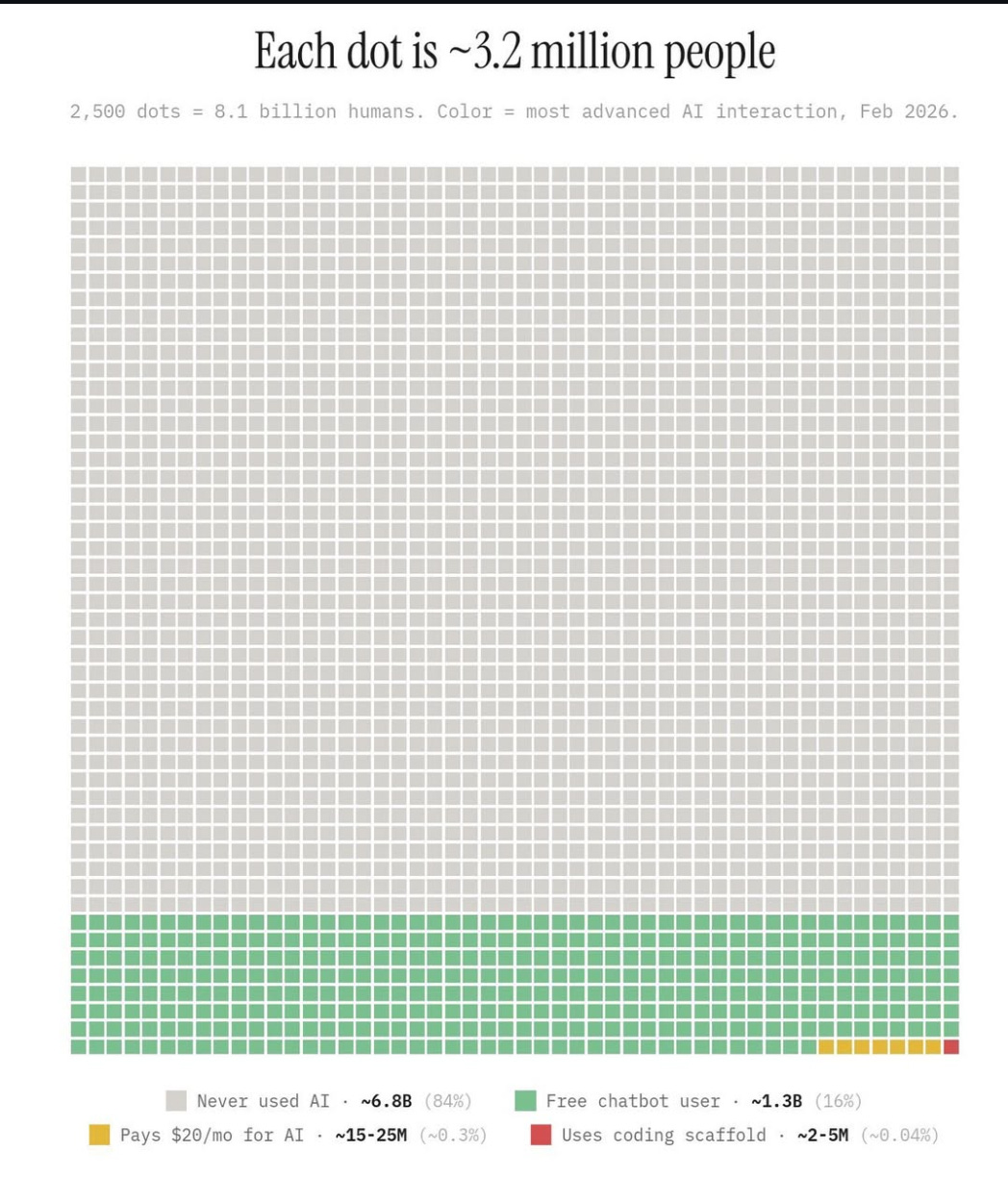
And the 16% who have? That includes the teenager who used ChatGPT once for a late homework assignment. The bar for “has interacted with AI” is on the floor, and 84% of the planet is still under it.
That number reframed things for me. I’m wondering if my barber knows what an MCP server is, and meanwhile 6.8 billion people haven’t even had the “hey, ask ChatGPT” moment yet. The bubble I’m worried about isn’t even visible from where most of the world is standing.
The article frames it as either a crisis or an opportunity. I think it’s both. But mostly it’s a reality check for anyone — myself included — who spends too much time on tech Twitter and starts thinking the whole world is vibe coding.
So Is It a Bubble?
Maybe. I really don’t know. It’s hard to say. But I just wanted to share my Reddit experience with y’all.
I do agree though, it’s a social bubble, not a technology bubble.
The technology is real. I watched my girlfriend, someone who does not know what Git is, replace her entire SaaS stack. A radiologist automated his workflows in a day. People are building real things that solve real problems. That’s not hype. That’s evidence.
But the conversation around it? Total bubble. Twitter, Reddit, LinkedIn have created a world where it feels like everyone is vibe coding at a PhD level and if you haven’t automated your entire life you’re falling behind. That’s not real. 84% of the planet hasn’t even tried AI once. Our echo chamber isn’t just loud. It’s microscopic.
My friends think everyone will be vibe coding by Christmas. The skeptics think it’s all hype. Both might be right. AI is genuinely transformative for people who need what it does. It’s completely irrelevant to people who don’t. And that’s the same pattern as every major tech shift. The internet in ‘95. Smartphones in ‘08. The early adopters weren’t wrong. They were just early. And the people who ignored it weren’t stupid. They just didn’t need it yet.
We’re in the “early adopters who think everyone else is crazy for not adopting” phase. The gap will close. Not because everyone will learn to orchestrate 20 agents, but because the tech will meet people where they are.
We’re All Just Cooking
So if you’re one of my 20 followers who actually uses this stuff — yeah, you’re ahead. Enjoy it. Build something. Ship it, ideally, unlike me.
We’re all just cooking. Some of us are making incredible pasta. Some of us should probably not open a restaurant. The bubble isn’t the technology — it’s the echo chamber of people who think they’re the only ones who noticed fire is hot.
Takeaway: The tech is impressive.
The 12% of reddit comments categorized in the “Other” category had to be wild..
With any AI topic with non-tech friends and family it constantly feels like this meme https://imgflip.com/i/aog1w3
Quotes I giggled at :')
Have you ever asked your friends what APIs are?
You don't see me wandering into r/quantumphysics with opinions
I’m wondering if my barber knows what an MCP server is